

ART AT WORK
A recent walkthrough of the jam-packed art collection in Mayor Wilson’s offices sheds light on how artistic practice can (and cannot) be used to represent a political platform.
WRITTEN BY KEMI ADEYEMI
PHOTOGRAPHY BY MERON MENGHISTAB
The Jacob Lawrence oil painting Eight Builders (1982) hangs like a beacon at the end of the hallway entrance to the new Seattle Mayor Katie Wilson’s offices. The painting, depicting a scramble of Black woodworkers amidst their materials and tools, hangs opposite Jake Prendez’s oil painting, And Still I Rise (2024), wherein a horde of anti-immigration protestors hurl stones at a young woman ascending to the sky with monarch butterfly wings. The two works frame one’s entrance into the closed interior of the Mayor’s offices, starting points into how her administration imagines itself and its work. The paintings emblematize the inclusive messaging of most political movements along the liberal-to-progressive spectrum — anti-racist, pro-immigrant — and are a fitting representation of Mayor Wilson’s “affordability agenda” as it is lodged in commitments to workers.
A recent walkthrough of the jam-packed art collection in the Mayor’s offices sheds light on how artistic practice can (and cannot) be used to represent policy, and tells a perhaps more interesting story about what happens when we take art and artists seriously as central to good governance.
Seattle is one of the few cities in the country with its own art collection: nearly 4,000 works across mediums. Funds for collecting and exhibiting this work are secured through the 1 Percent for Art ordinance (1973), which allocates 1% of capital improvement funds to variously collect, commission, and install art in the city. These resources have allowed the city to install hundreds of works in parks and passageways across the city — still more are housed within the buildings that city employees work in day in and day out, including City Hall. Cheryl Delostrinos, a community relations manager in the Mayor’s office, was charged with the task of installing a collection of works that communicate Wilson’s particular investments in affordability, representing the city’s diversity, and uplifting workers. Delostrinos worked with the artist Blake Haygood, Curator and Collections Manager of the city’s Civic Art Collection, to choose from the nearly 400 pieces of art that can be rotated into any number of government locales.
(LEFT & RIGHT) Diem Chau, Long Braid (2008)
(CENTER) Malayka Gormally, Woman Applying for United States Citizenship at the International Rescue Center in Tukwila (2019)
Public servants in different departments are central to the processes of identifying, paying for, permitting & distributing art across Seattle. This is a great feat of governance.
The result is a strangely compelling exhibition of work by artists with strong roots in the Pacific Northwest. (A few are from far beyond the region, including a print by Mary Lee Bendolph, of the world-renowned Gee’s Bend quilting community in Alabama.)Nearly every hallway space is filled with primarily figurative, two-dimensional work that is often grouped in pairs and trios to facilitate conversation between works. A standout trio features two minimalist, embroidered silk and porcelain works by Diem Chau, jointly called Long Braid (2008), which frame an ink, watercolor, and gouache piece by Malayka Gormally, Woman Applying for United States Citizenship at the International Rescue Center in Tukwila (2019). The detailed handcraft Chau puts into the long black braid that extends from each delicately embroidered figure, hanging far below the porcelain plates on which they are centered, complements the focused processing of the woman Gormally depicts. Her subject wears a graphic t-shirt and hijab as she nears the end of her application form, the entirety of the loaded citizenship process seeming to concentrate in the grip of her fingers on the edge of the application form as she reaches the bottom of the page. At first glance, all three works threaten to blend into the beige background of the office, as the fine lines of each piece are framed in light wood and white and off-white mats, but their pops of material (the long braids) and color (the red hijab) draw the viewer closer in ways that match the meticulous nature of Chau, Gormally, and their subjects.
Another standout of the collection showcases artists working within, and pressing the boundaries of, a single medium. The entirety of the “Historical Conference Room” is ringed by 11 framed serigraphs and Giclée prints by Indigenous printmakers whose works ruminate on communal, if sometimes fractious, bonds among human-animal-environment. The hanging style allows the viewer to be anchored in the tenets of the formline tradition exemplified by Preston Singletary, Dennis Allen, and lessLIE Sam’s serigraphs, while colorful Glicée printing of artists like Kelly Cannell demonstrate expansions of the style. (Elsewhere in the exhibition, Singletary’s glass sculpture Raven Crest Hat [2002] deserves more pomp and circumstance — while it benefits from the abundant natural light of the lobby that overlooks Elliott Bay, it feels too tucked behind the space’s generic office furniture.)
There are plenty of formalist conversations to be had between works that are not hung near to one another, as happens when you take Chris Engman’s forest-based photographic play with foreground and background, and consider it alongside the figure quietly paddling away from the 8mm camera in a still from Clyde Petersen’s documentary about the PNW band, Earth. Yuji Hiratsuka’s Fashion Produce L print feels very ’90s until you put it in conversation with the color palette and materials that Megan Patterson uses in 2021 for Exalted. Patterson’s use of graphite and pigment powder to soften the thickness of acrylic paint, and incorporation of 24-karat gold leaf, create a similar effect to the delicate layering of material in Hiratsuka’s broader plays with printmaking.
The collection of works is dominated, in a sense, by two photographic series: one focusing on the Alaskan Way Viaduct just before its demolition, and the other a collection of photographs commissioned by Seattle City Light and Seattle Public Utilities documenting essential workers during the COVID shut-down. The first set of images marks a major transformation in how the city imagines itself, trading a concrete thoroughfare for a walkable waterfront aimed at increasing residents’ quality of life and encouraging tourist dollars. The latter photographs also represent and honor the working- and middle-class workers implied in many of Wilson’s affordability discussions. The numerical prominence of these photographs gestures toward the challenges of making an art collection represent a mayoral agenda — and just as there is a long, documented history of how art is folded into, say, socialist political movements up through the 1970s, this particular exhibition neatly reflects the liberal political agendas of the late 2020s.
(LEFT TO RIGHT) Dennis Allen, Thunderbird and Whale (2004); Dennis Allen, Potlach Gathering (2018); lessLIE SAM, Songs of Salmon People (2018); Trevor Husband, Into the Deep (2022)
As each work of art in the Mayor’s office becomes part of a collective picture of her platform, there emerges an overwhelming idealism that by and large skips over the sheer amount of work it takes to get there.
There is only so much an exhibition, like a politician, can represent. The curatorial emphasis on photographic realism makes sense for a political platform aimed at building a city that is livable for everyone. Simply representing the fact that many kinds of people exist within a single geographic area can be immensely important for building the empathy and buy-in needed for new, expensive, ambitious kinds of infrastructure: the kinds that make livability equitable and sustainable. As each work of art in the Mayor’s office becomes part of her collective picture of her platform, created in the service of the people she represents and the city she works toward, there emerges an overwhelming idealism that by and large skips over the sheer amount of work it takes to get there. We see images of the viaduct before it is deconstructed. We don’t see it being torn down, crumbling, in the midst of transformation; there is no process, just outcome. Achieving the Mayor’s vision and values will require great transformation in sentiment and action. Posed as an expression of this vision and value, the collection misses the opportunity to deeply engage with the inevitable and enduring power struggles that such transformation requires.
A curious bright spot does exist, however. In her social reality painting, 8 Hour Work Day (For Ralph Fasanella) (1995), Ross Palmer Beecher has painted scenes on carved wood panels that are inlaid into the recess of the underside of a car hood and doors. The left panel depicts rioting workers breaking glass and setting a warehouse ablaze, the right panel a scene of a baseball game. The largest, center panel, inlaid into the underside of a car hood, features men working a car assembly line with harsh overhead lighting. A scene recalling the crucifixion of Jesus is painted above them. Here, though, an upright muffler assumes the vertical beam of the cross, the horizontal beam a front-facing car. A worker who has paid for the sins of industry has been crucified here, his body slack, his head slumped. In his right hand a driver’s wheel, in his left a wrench.
The piece narrativizes the complex range of feelings of people who deserve dignity as workers and as city dwellers who should have the right to financially and emotionally afford play and leisure (represented by the baseball game). In specifically depicting the anger and the sacrifice of workers, Beecher confronts the public-private collaborations that are at the heart of the very destruction of affordability, inclusivity, safety, shared prosperity, and sustainable, environmentally considerate infrastructure that Wilson’s administration seeks to repair. 8 Hour Work Day is in many ways the piece that perhaps best reflects the feelings of the people who propelled Wilson into office, and yet it is hung in an especially dark, low-traffic hallway of the offices in which she and her staff work.
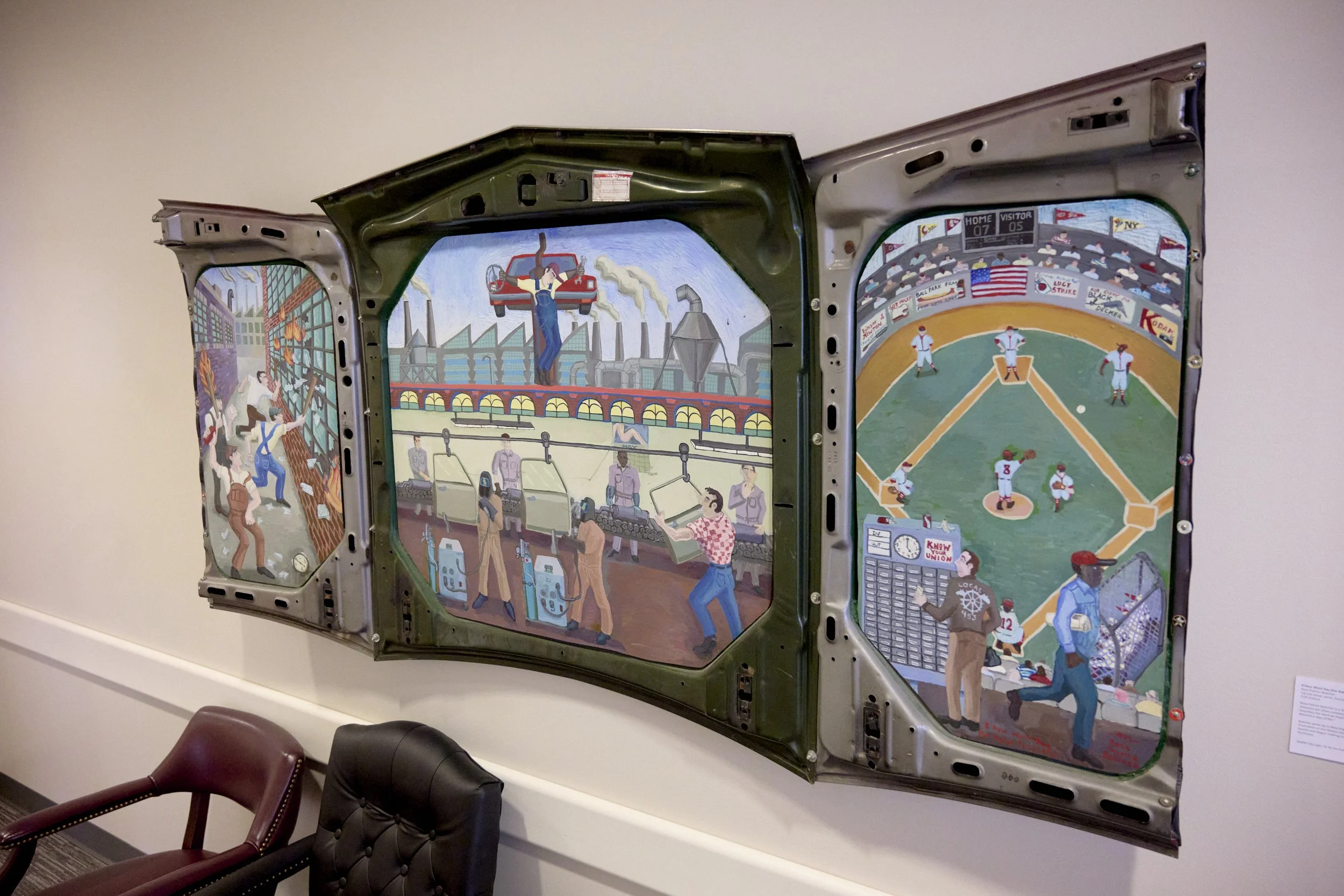
Ross Palmer Beecher, 8 Hour Work Day (For Ralph Fasanella) (1995)
It is certainly not easy to hang art in government buildings. They are impersonal spaces with terrible lighting. The artwork has to be completely neutral or, if it does represent a political agenda, it can’t be too political, definitely not too incendiary. (There is a reason that we see Jacob Lawrence’s engagement with workers instead of, say, something from his series on Toussaint L’Ouverture.) There are limits, then, to reading and analyzing the work on the walls of the Mayor’s office as having any material relationship to political process — the work can only ever be an aesthetic manipulation of an idea. If we want to read the Mayor’s relationship to art as an expression of what she and any given mayoral administration can do, we would do better to look away from the art objects themselves and toward the processes through which they come into the city’s possession and are put on display.
The Office of Arts & Culture (OAC) manages the massive Civic Art Collection through a refreshing model of participatory democracy that is unusual amidst local and national forms of governance, wherein the definitions of representation feel increasingly strained. The collection began in 1973 under the helm of the Seattle Arts Commission (later OAC), which funneled money and opportunity to artists using resources from the federally funded Comprehensive Employment and Training Act (CETA), the largest federally funded project since the New Deal programs of the 1930s. There became a concerted effort to fund artists in Seattle — as well as cities like Los Angeles, Chicago, and Philadelphia — through programs like The Artist in the City, wherein artists created works that were later purchased for the Collection. Over the decades, the collection process has moved away from a small, hierarchical group of decision-makers that skewed toward collecting primarily white male artists to become an increasingly team-based, participatory process of shaping who and what is included into and displayed from the Collection. Ventures such as Fresh Perspectives incorporate youth as curatorial decision-makers, and have been central to expanding the collection to better reflect the region’s diversity; the Public Art Roster identifies and provides opportunities for artists who want training in the complicated proposal and pitching processes involved in working with the city; and employees participate in committees that engage with collection and curation processes.
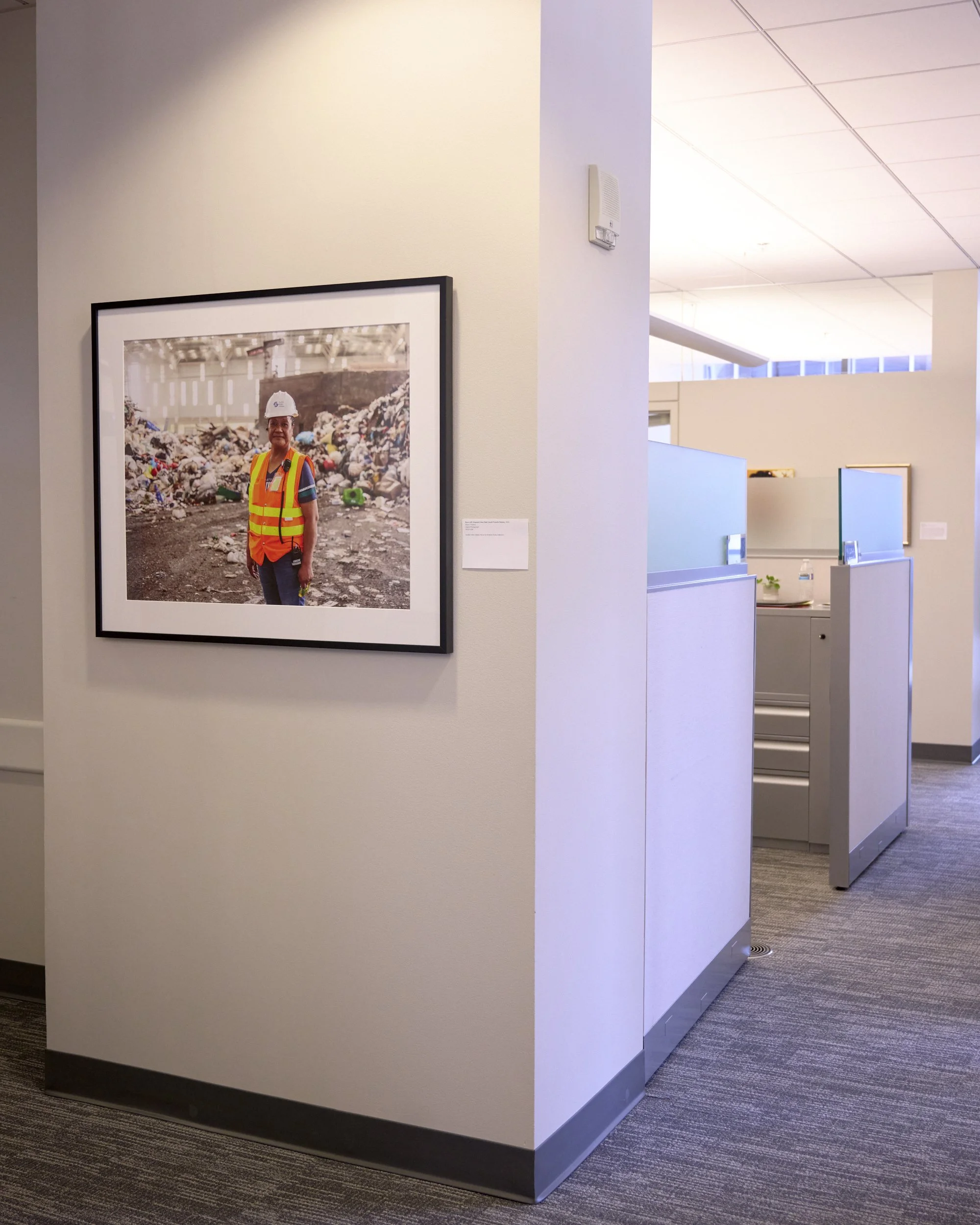
Shann Thomas, Rosa Leifi, Disposal Crew Chief, South Transfer Station (2020)
This model of tending toward public servants, and toward the spaces of city governance, lies in sharp relief to the ways local and federal governments position public servants as enemy agents.
The COVID-19 pandemic permanently changed many building-access procedures, meaning that many of the city’s greatest works are only accessible to public servants, a point that reinforces the many ways the Civic Art Collection is described by Delostrinos and Haygood as a city employee collection, first and foremost. Public servants are given decision-making power over, and priority access to, a vibrant art collection, and are afforded the dignity of being treated like people who are interested in and capable of sitting with, thinking about, and certainly working amidst beautiful things. This model of tending toward public servants, and toward the spaces of city governance, lies in sharp relief to the varied ways local and federal governments position public servants as enemy agents.
The art in the Mayor’s office does not need to be more than a rhetorical gesture. If one does, however, want to bridge the gap between what a given administration says and what it actually does, there is guidance in the material processes through which the Civic Art Collection exists and is managed. There, we find a picture of how government that works with and for the people might work; a picture of the sheer amount of deeply boring, complex work it takes to make government work.
The processes through which the Civic Art Collection is created and maintained illustrate how to enact lush ideas, such as embedding beautiful art throughout the city: ambitions that are considered increasingly controversial in eras of intense partisan debate, government downsizing, and entrenched social stratification. The processes are a reminder that monumental ideas are often mundane and achievable, because they live almost entirely within boring and complex administrative processes. In Seattle, public servants in many different departments have been made central to the processes of identifying, paying for, permitting, and distributing art across the city. This is a great feat of governance, due in no small part to the fact that it is very hard work with people to co-construct something like a shared reality — organizing is not easy, and the mountain of work it requires has spelled the failure of many political movements.
The Mayor, like any politician, is but the figurehead of a larger administration. The political and social power of her agenda lies less in the representational economies of the art on her office walls and in her campaign buzzwords than in the actual, mechanical details of work that these public servants do. The mechanical details of how they envision the value of art for themselves and the greater city provide models of governance for and by the people that we would do well to (re)consider in the years to come.
Disclosures: Kemi Adeyemi runs The Black Embodiments Studio, which received a 2025 financial award from the Seattle Office of Arts & Culture to fund an Art Critics Apprenticeship program, which seeds arts writers in local publications. In April, CHUM News was approved for an OAC-administered smART Ventures grant to fund its monthly column, “Ferry Tales.” And Meron Menghistab’s photographs were recently selected to be hung in a Mayoral staff member’s office.
KEMI ADEYEMI is Associate Professor of Gender, Women & Sexuality Studies at the University of Washington. She founded and directs The Black Embodiments Studio, an arts writing incubator, public programming initiative, and publishing platform dedicated to building discourse around contemporary black art.
MERON MENGHISTAB is a South Seattle-based and -raised photographer working primarily in narrative structured work. He is the Art Director of CHUM News.